
Business Problem
As a catalog grows, the lack of a proper product variant system quickly becomes a sales constraint. Sizes, colors, and other options stop being a small admin detail and start affecting catalog structure, frontend UX, listing quality, and overall discoverability of the offer.
This was not a one-screen problem. It required a system that could be scaled, reliably fed with data, and exposed to customers in a way that made sense both on product listings and on product detail pages.
What I Built
I designed and implemented a full product variant system covering backend, public API, and the web layer.
The scope included:
- database migrations,
- Prisma models for specifications and variant groups,
- specification management,
- bulk AI-based validation,
- a public API for variants and options,
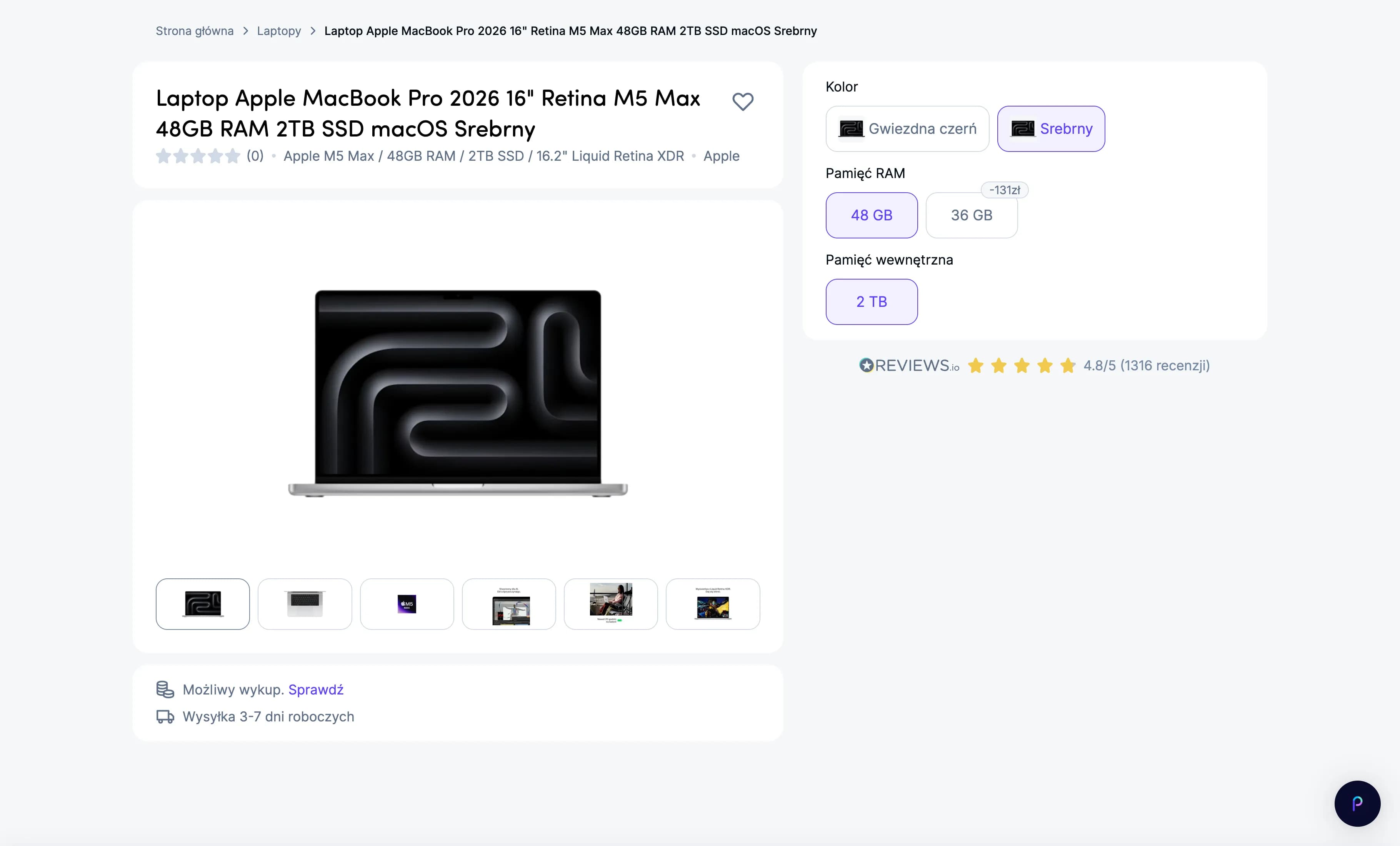
- frontend variant selection for things like size and color,
- a related-products carousel,
- a sticky "Add to cart" CTA,
- A/B tests on MOW tiles.
Technical Decisions
The most important architectural decision was separating the data layer from the presentation layer. That made variants a first-class part of the product domain instead of a UI afterthought. In practice, that opens the door to better filtering, cleaner listings, and more controlled growth of the catalog.
Bulk AI validation solved another very practical problem: data quality at scale. With a large number of products, manual validation becomes slow and error-prone. Automating that part allowed the rollout to keep pace without spending team time on repetitive verification work.
Sales Layer
On the web side, I did not treat variant selection as an isolated feature. Size/color choice, related product carousel, and sticky CTA were designed as one decision-support flow rather than three disconnected UI additions.
That meant users could understand the available options faster, compare nearby alternatives more easily, and always have a clear path to add the product to cart. This matters especially on mobile and on long product detail pages.
Impact
At launch, the system was already powering 150 parent products, so this was not architecture "for later". It was a production-ready system delivering value from day one.
This case study reflects how I approach complex e-commerce work: I connect data architecture, customer experience, and commercial experimentation so the system is not only technically sound, but immediately useful for revenue growth.


