
Business Problem
Returns are often the last moment when a company can still recover the customer. In this flow, once a user decided to end the order, the product experience pushed them almost straight to exit. Operationally that was simple, but commercially it increased churn and left no real room to retain revenue.
The goal was precise: reduce churn on returns from roughly 45% to 30% across all rental periods. To do that, the user needed a real reason to stay, one that appeared exactly at the moment the leaving decision was being made.
Solution
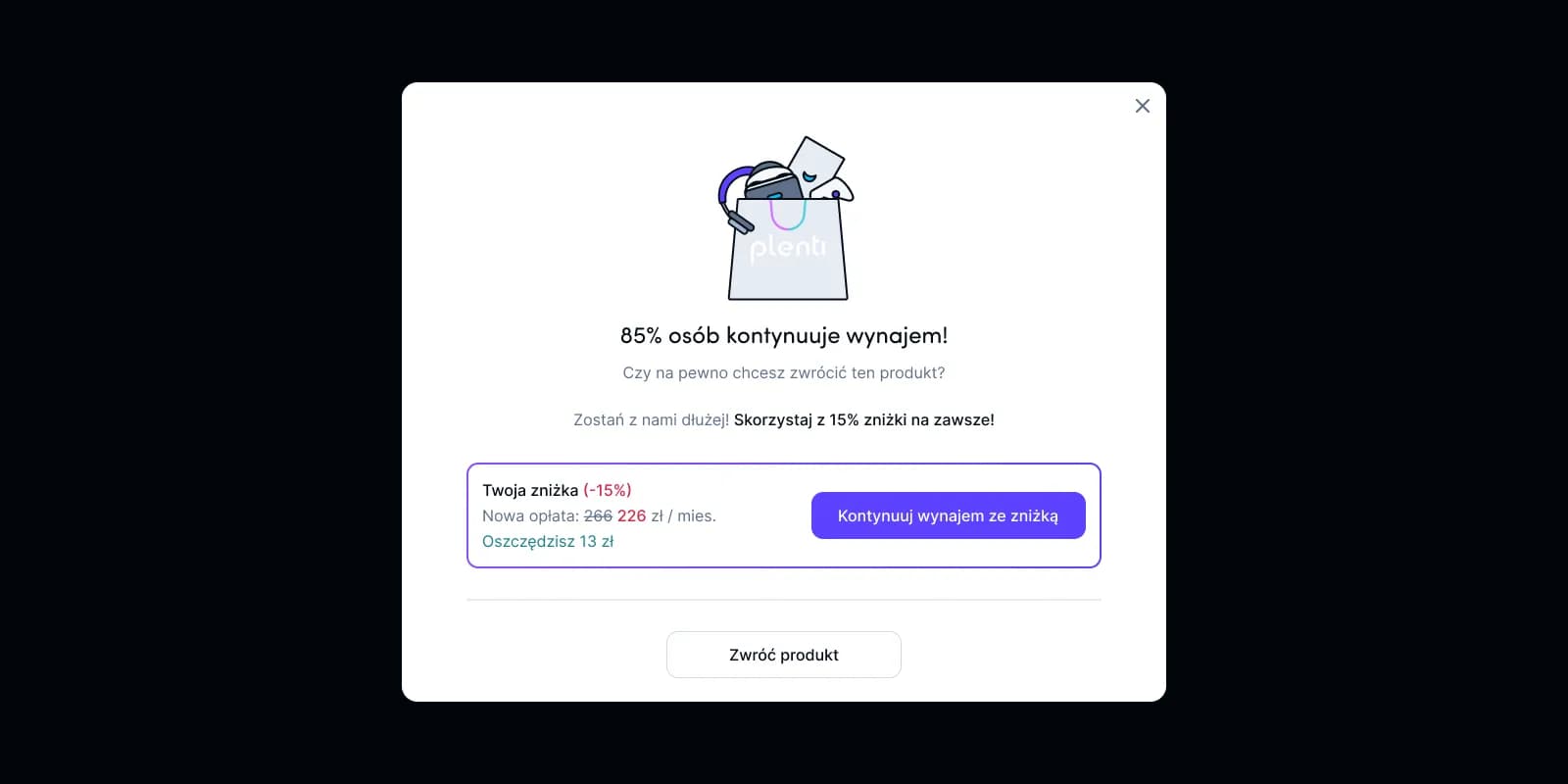
I implemented an option to extend the order with a 15% discount instead of proceeding directly to return. The offer was available only once per order and surfaced directly inside the return flow, so the user did not need to contact support or switch channels to act on it.
That detail matters. Retention mechanics work best when the alternative appears exactly at the friction point. The more steps there are between the intent to leave and the counter-offer, the lower the chance that the user will reconsider.
Scope
I delivered the feature full-stack across:
- the admin panel,
- the web flow,
- the mobile application,
- safeguards preventing the same order from using the discount multiple times.
Because of that, the team did not receive "just a promotion", but a complete and controllable retention mechanism with clear usage rules.
Why It Works
In many products, churn is not caused by a permanent lack of need, but by temporary price resistance or an overly easy cancellation path. This mechanism targeted exactly that moment. The customer did not have to make a new complex decision, they were simply given a clear choice: end the service or continue it at a lower price right away.
Impact
This implementation was designed as a retention tool for one of the most expensive moments in the funnel. The target business outcome was clearly defined: reduce return-related churn from around 45% to 30% across all rental periods.
This case study shows an important pattern: meaningful revenue impact does not always come from acquiring more users. Sometimes it comes from redesigning the moment when an existing customer is about to leave.


